Trout Fishing Water Temperature Guide: The Perfect Degrees for Each Species
Last June I watched a buddy of mine drive four hours to a tailwater fishery in Tennessee, fish all morning, and land exactly nothing. Meanwhile, the guy downstream from him was pulling rainbows every ten minutes. Same water. Same flies. Different result.
The difference? My buddy was wading water that was pushing 68°F — right on the edge of trout's thermal comfort zone. The guy downstream had found a cold spring seep keeping that stretch around 58°F. The fish had stacked up on it like it was a buffet.
Water temperature isn't just a data point. It's the entire game plan. Once you understand how trout relate to temperature, you stop fishing water and start fishing the right water.
Why Water Temperature Controls Everything
Trout are cold-blooded. Their body temperature matches the water around them, which means water temperature directly controls their metabolism. Warm water = faster metabolism = more energy needed = more feeding. Sounds good, right? Not so fast.
Warm water also holds less dissolved oxygen. When temps spike past a trout's optimal range, their oxygen demand increases just as the available supply drops. That's a recipe for lethargic, stressed fish sitting in the deepest, coldest water they can find — not chasing your lure.
Here's what's actually happening in the water column at different temps:
- Below 40°F — Metabolic rate tanks. Trout are alive but barely interested in burning calories.
- 40–55°F — The prime feeding window opens. Fish are active, aggressive, and catchable.
- 55–65°F — Peak activity for most species. Fast metabolism, maximum aggression.
- 65–70°F — Feeding slows. Fish get selective and start seeking cold refuges.
- Above 72°F — Stress zone. Fish survival becomes the priority, not feeding.
- Above 78°F — Lethal for most trout species within hours.
Field note: I keep a simple stream thermometer in my pack every single trip. Takes five seconds to check, and it's saved me from wasting entire mornings more times than I can count.
The other thing temperature does is control spawning. Every trout species has thermal triggers that kick off their spawning runs. Miss that window, and you're either too early (fish not in position) or too late (fish recovering and not interested in eating).
Rainbow Trout Temperature Sweet Spot
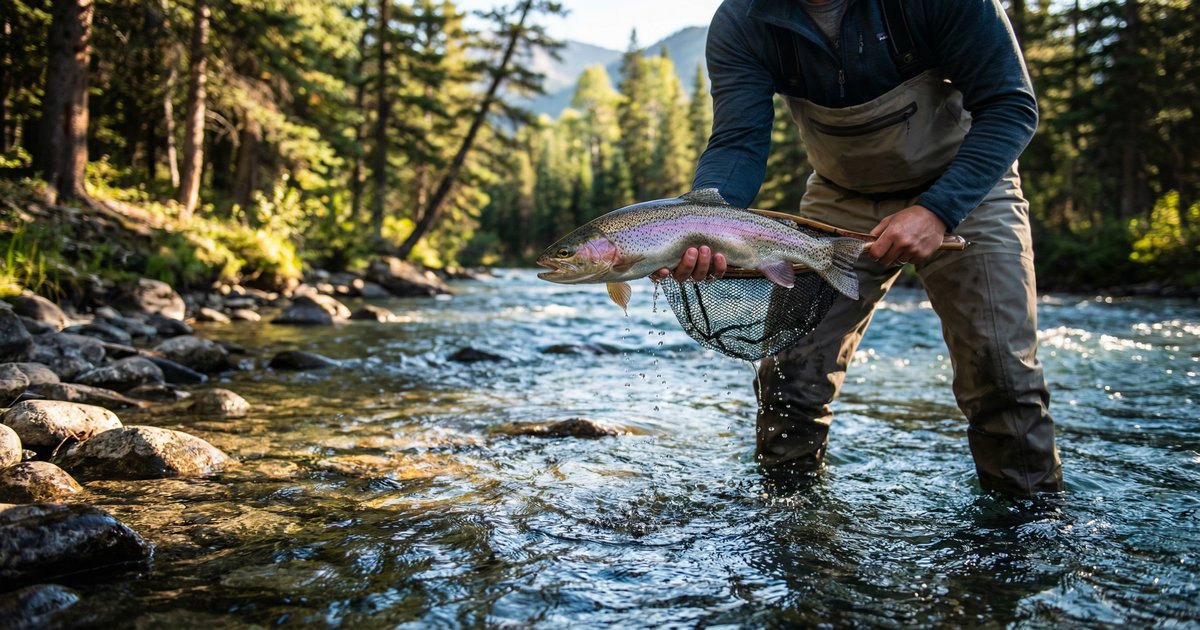
Rainbows are the most widely distributed trout in the country — stocked in everything from small farm ponds to massive western tailwaters. They're also the most temperature-tolerant of the common trout species, which is part of why they've adapted so well.
Optimal Feeding Range
55–65°F is where rainbows really turn on. In that range, their metabolism is running hot enough to demand consistent feeding, but the oxygen levels are still comfortable. This is when you'll see surface activity, aggressive strikes on streamers, and fish stacked in feeding lanes.
At 48–54°F, they're still feeding well — just a little slower. Nymphing deep or dead-drifting smaller presentations works better than fast-moving streamers.
When water climbs past 67°F, rainbows start pulling back. They'll move to deeper runs, spring holes, or tailouts where cold tributaries enter. If you're fishing a summer stream and the bite goes dead by 10 a.m., it's almost always a temperature problem.
Spawning Temperatures
Rainbows are spring spawners. They move onto gravel redds when water temps hit 42–55°F — typically February through May depending on your latitude and elevation.
Wild steelhead (sea-run rainbows) are running on a different timeline depending on the strain — winter runs, summer runs — but water temperature is still the trigger that gets them moving and holding in specific lies.
During spawn: Fish are visible and tempting, but most ethical anglers avoid targeting fish directly on redds. Focus on fish staging below the spawning areas — they're feeding and catchable without damaging the nest.
Brown Trout Temperature Guide
Brown trout are the dark horse of the trout world. They're more tolerant of warm water than rainbows, more nocturnal in their feeding habits, and significantly harder to pattern. But understanding their temperature preferences unlocks them.
Optimal Feeding Range
Browns thrive in 54–65°F, with peak activity around 60°F. They can survive in water up to 75–77°F — better than any other trout species — but they stop feeding aggressively long before that point.
Here's what most anglers miss: brown trout feeding intensity is highly time-dependent in warm conditions. In summer, you might fish a river at 2 p.m. when the water is 68°F and catch nothing. Come back at 5 a.m. when overnight cooling has dropped it to 62°F — completely different fishing.
Brown Trout Spawning Temperatures
Browns are fall spawners, and this is actually one of the best times to target them. Water temperatures in the 44–54°F range (typically October–December) trigger both spawning movement and aggressive feeding as fish bulk up for winter.
The two weeks before browns move onto redds is legendary fishing. Fish that were impossible to fool all summer suddenly start hammering streamers at weird hours. Big browns — the ones you never see — start making mistakes.
Pro tip: Watch the water temperature in late October. When it drops consistently below 52°F in the afternoons, start throwing large articulated streamers at dawn and dusk. That's your window.
Brook Trout and the Cold Water Specialists
Brookies are native Eastern trout and the most cold-water-dependent of the common species. If you're fishing high mountain streams, remote Maine ponds, or shaded Appalachian creeks, you're likely targeting brookies.
Optimal Range
50–60°F is prime. Brook trout start showing stress at 65°F and are in serious trouble above 70°F. Their narrow thermal range is why they've lost ground to rainbows and browns across much of their historic range — those species handle warmer, more degraded water.
But in cold, clean headwaters? Brookies are untouchable in terms of sheer aggression. They'll hit almost anything.
Where Temperature Dictates Location
In summer, brook trout fishing becomes a game of finding cold water within cold water:
- Spring seeps — Look for subtle temperature drops, often visible as slightly different water clarity or color
- Shaded north-facing runs — Can be 3–5°F cooler than sun-exposed stretches
- Deep pools with cold groundwater input — Brookies will stack in these during heat waves
- High elevation — Every 1,000 feet of elevation typically drops average water temps by about 3–4°F
Lake-run brook trout (coasters in the Great Lakes region) move offshore into deeper, cooler water during summer — sometimes to depths of 40–60 feet where temperatures sit in their comfort zone.
Cutthroat and Lake Trout Temperature Considerations
Cutthroat Trout
The native trout of the Mountain West and Pacific Northwest, cutthroats occupy some of the most dramatic terrain in the country. Temperature preferences mirror rainbows but skew slightly cooler.
Optimal range: 50–60°F
Lahontan cutthroats (Nevada/California) tolerate slightly warmer temps than Yellowstone or Westslope cutthroats. Rio Grande cutthroats in New Mexico high country are extreme cold specialists — their small, headwater streams rarely break 60°F even in summer.
Cutthroat spawning runs hit on 42–52°F water temps, generally April through June. In high-elevation streams, this might push into July.
Lake Trout
Lakers are the deep-water specialists. They're not stream fish — they live in large, cold lakes from Alaska through the Great Lakes and deep into Canada.
| Season | Target Depth | Water Temp |
|---|---|---|
| Ice-off (Spring) | 0–15 ft | 38–48°F |
| Early Summer | 15–40 ft | 48–58°F |
| Peak Summer | 60–120 ft | 50–55°F |
| Fall Turnover | 10–30 ft | 50–55°F |
| Ice Fishing | 20–80 ft | 34–40°F |
Lake trout spawn in 48–55°F water — fall spawners like browns, typically September through November. Unlike stream trout, they spawn on rocky shoals in the lake rather than in tributaries. The fall period when they're shallow and pre-spawn is some of the best lake trout fishing of the year.
How to Use Temperature to Find Fish in Real Time
Knowing the numbers is half the equation. The other half is putting them to work on the water.
Reading Thermal Refuges
When surface temps are high, look for anywhere cold water enters the system:
- Tributary mouths — Even a small, shaded feeder creek can drop temps 5–8°F in the plunge pool
- Tailwater fisheries — Dam releases maintain consistent cool temperatures year-round; some of the best summer trout fishing in the South is in Tennessee and Arkansas tailwaters
- Spring holes — Ground water in most of the U.S. emerges at 50–55°F year-round; springs are the air conditioning units of streams
- Deep pools — Where cold, heavy water settles out; fish stack here when surface temps spike
The Daily Temperature Cycle
Water temperature in smaller streams follows the air temperature — with a lag. On a hot summer day:
- Early morning (pre-sunrise): Coldest point of 24-hour cycle
- Mid-morning to noon: Temps rise as sun angle increases
- 3–5 p.m.: Peak temperature — often the worst fishing of the day in summer
- Evening through overnight: Gradual cooling
Plan your fishing around this cycle. Fish the first two hours of light and the last hour before dark in summer. In spring and fall, this matters less because the swing between high and low is smaller.
Using HookCast to Track Conditions
I use HookCast before almost every trip — specifically to check the weather trend and air temperature forecast for the previous 48 hours. Air temperature drives water temperature in streams, especially smaller ones. If I see three consecutive nights where lows dropped into the 40s, I know the trout are going to be aggressive in the morning. That's the kind of intel that changes where I decide to go.
Combine that with a $12 stream thermometer and you've got a real edge over anglers who just show up and guess.
Quick-Reference: Trout Temperature Cheat Sheet
Optimal Feeding Temperatures
| Species | Prime Range | Upper Limit | Stress Zone |
|---|---|---|---|
| Rainbow Trout | 55–65°F | 70°F | 72°F+ |
| Brown Trout | 54–65°F | 73°F | 77°F+ |
| Brook Trout | 50–60°F | 65°F | 70°F+ |
| Cutthroat | 50–60°F | 65°F | 72°F+ |
| Lake Trout | 48–58°F | 60°F | 65°F+ |
Spawning Temperature Triggers
| Species | Spawn Season | Trigger Temp |
|---|---|---|
| Rainbow / Steelhead | Feb–May | 42–55°F |
| Brown Trout | Oct–Dec | 44–54°F |
| Brook Trout | Sep–Nov | 48–55°F |
| Cutthroat | Apr–Jun | 42–52°F |
| Lake Trout | Sep–Nov | 48–55°F |
Key Takeaways
- Always check water temperature before you start fishing — not once, but in multiple locations on the same stream
- When temps exceed the upper limit, fish cold water refuges: tributary mouths, spring seeps, deep pools
- The best feeding windows in warm months are dawn to 9 a.m. — fish before the water heats up
- Pre-spawn fish (especially brown trout in October) are some of the most aggressive, catchable fish of the year
- Cold water = slow presentations; prime temps = match the hatch or go aggressive with streamers
- A $12 stream thermometer is one of the highest-ROI tools in your vest
The fish don't care what time it is on your watch. They care about water temperature. Start fishing that number, and you'll spend a lot less time wondering why the guy next to you is cleaning up while you're getting skunked.
FAQ
What is the ideal water temperature for catching trout?
The ideal range varies by species, but most trout are most active and catchable between 55–65°F. In this range, their metabolism is running efficiently, oxygen levels are comfortable, and fish are aggressive feeders. Temperatures below 40°F or above 72°F will significantly reduce your chances of success.
How do I find cold water refuges when temperatures get too warm?
Look for cold spring seeps, tributary mouths, shaded stretches, and deeper pools where cold water sinks. As the article's opening story illustrates, fish will stack up in these spots when surrounding water temps push into the stress zone. A stream thermometer lets you quickly identify these temperature breaks.
Do I need special equipment to monitor water temperature while fishing?
No — a simple stream thermometer is all you need. They're inexpensive, lightweight, and small enough to toss in any pack or vest pocket. Taking a quick reading before you start fishing and periodically throughout the day can save you hours of unproductive water.
Does water temperature affect trout the same way year-round?
Temperature matters in every season, but its effects shift throughout the year. In winter, cold temps slow metabolism and reduce feeding. In summer, warm temps stress fish and push them into refuges. Spring and fall often offer the most consistent feeding conditions as temps naturally fall into the optimal range for most species.
Should I stop fishing when water temperatures get too high?
Yes — when temperatures exceed 72°F, trout are physiologically stressed and fighting for survival rather than feeding. Catching and handling fish in these conditions significantly reduces their survival odds even after release. Most conservation-minded anglers follow a practice of avoiding trout fishing when water temps consistently exceed 68–70°F during summer months.