North & South Carolina Coast Fishing: Flounder, Drum & Sheepshead Spots
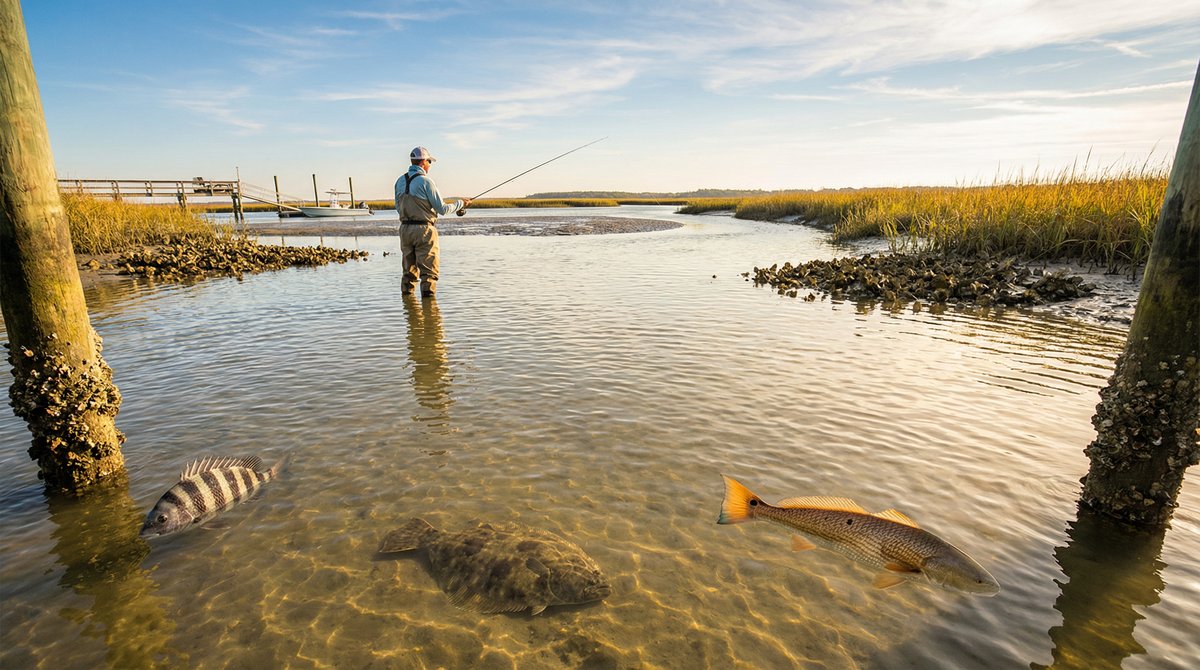
A Tuesday morning in late September. I'm standing knee-deep in a tidal creek off Masonboro Island, watching a cormorant work the same oyster bar I'm about to fish. That bird isn't there by accident. Neither are the flounder sitting just off the drop where the creek bends into the marsh grass.
The cormorant knows what I know: when the tide pulls water out of those shallows, baitfish get squeezed into a narrow slot, and ambush predators set up right below them.
That's the Carolina coast in a nutshell. Whether you're fishing the Outer Banks or the ACE Basin, the fish tell you where to be — if you know how to read the water. This guide breaks down the best spots and strategies for three of the most sought-after inshore species along the Carolina coast: flounder, red and black drum, and sheepshead. Each uses structure and tidal flow differently, and once that clicks, everything else follows.
How the Carolina Coast Is Built (And Why It Matters)
The Carolina coastline isn't one thing. It's a patchwork of barrier islands, tidal creeks, estuaries, river inlets, rock jetties, and nearshore reefs — and that variety is exactly what makes it such a productive fishery.
North Carolina is defined by the Outer Banks, a narrow chain of barrier islands separating the Pamlico and Albemarle Sounds from the Atlantic. The Pamlico Sound is the largest lagoonal estuary on the East Coast — NOAA Fisheries identifies it as critical nursery habitat for dozens of inshore species. Inlets like Oregon, Hatteras, and Ocracoke concentrate tidal exchange and, with it, fish.
South Carolina offers a drowned coastline with deeper tidal creeks, broader estuaries like Port Royal Sound and the ACE Basin, and harder structure — bridge pilings, jetties, and inshore rock piles — particularly along the Grand Strand and around Charleston. The tidal range near Charleston often hits 6 to 7 feet, significantly larger than much of North Carolina, which compresses and intensifies feeding windows.
Field note: A big tidal range doesn't automatically mean better fishing — it means the bite windows are more compressed and more predictable. When the tide really moves, so do the fish. Missing that window by an hour can be the difference between a cooler full of flounder and an empty one.
I pull up tide charts for my target area the night before every trip — not just for high and low times, but for the rate of change. That slope is what drives baitfish movement, and baitfish movement is what drives everything else.
Flounder: Finding the Ambush Zones
Flounder are sit-and-wait predators. They don't chase bait down the creek — they pick a spot where current delivers bait to them and they wait. Your job is to find that spot before they do.
Structure to Target
In both Carolinas, flounder concentrate on:
- Drop-offs at tidal creek mouths — where the creek floor transitions from 2 feet to 6 feet as it meets a larger body of water
- Oyster bar edges with adjacent sand — flounder lie on the sand next to oyster structure, not on top of it
- Inlet channel lips — Oregon Inlet, Murrell's Inlet, and Lockwood Folly Inlet all hold flounder in the moving water along channel edges
- Bridge shadow lines — the downcurrent side of pilings creates a current break where flounder stack
Best Times and Tides for Flounder
The outgoing tide is the standard for Carolina flounder fishing — particularly the last two hours of the ebb. As water drains from marsh flats and creek systems, mud minnows, finger mullet, and small crabs get swept downcurrent through bottleneck points. Flounder post up at exactly those bottlenecks.
In South Carolina's larger tidal systems — Beaufort or the North Edisto — the outgoing push can run 3 to 4 hours. That's a long productive window if you're positioned correctly from the start.
Best flounder spots by location:
| Location | Structure Type | Best Tide |
|---|---|---|
| Wrightsville Beach, NC | Intracoastal drop-offs, creek mouths | Outgoing |
| Masonboro Inlet, NC | Channel edges, inlet shoals | Incoming or outgoing |
| Murrell's Inlet, SC | Dock pilings, channel bends | Outgoing |
| Beaufort, SC | Tidal creek drops, oyster edges | Outgoing |
| North Edisto River, SC | Marsh creek mouths | Late outgoing |
Flounder Rigs and Baits
Live bait outperforms everything else. Mud minnows (mummichogs) are the standard on both coasts — they're hardy on the hook and flounder eat them readily. Live finger mullet in the 3–5 inch range are excellent in late summer and fall when the mullet run is on.
For artificials, a 1/4 oz jighead with a Gulp! Swimming Mullet in new penny or chartreuse dragged slowly along the bottom has accounted for more flounder in my boat than I can count. The emphasis is on slowly — if you're not occasionally ticking the bottom, you're fishing too high. Flounder will barely rise off the substrate to eat.
Pro tip: When you feel a flounder bite, pause. They grab and run short — setting immediately pulls the bait away from them. Give it a 2-count, then sweep the rod up firmly.
Red Drum and Black Drum: Two Species, Very Different Approaches
Red Drum on the Carolina Coast
Red drum — redfish or channel bass, depending on who you ask — are arguably the signature inshore fish on the Carolina coast. NOAA Fisheries notes that red drum use estuaries as nursery habitat through their juvenile and sub-adult years, which is why the Carolina sounds and tidal systems hold such consistent populations.
Most anglers target slot fish (18–27 inches in NC, 15–23 inches in SC — always confirm current regulations with your state agency). These fish root around shallow marsh areas over oyster rakes, spartina grass edges, and sand flats adjacent to deeper channels.
Key red drum locations:
- Pamlico Sound flats, NC — Large redfish schools roam the sound in fall, particularly October through early December. Sight fishing with DOA Shrimp lures or Zara Spooks on a flat calm morning is as good as inshore fishing gets.
- Cape Lookout, NC — The backside of the cape holds extensive grass flats and protected bays. Incoming tide pushes reds up into the grass.
- ACE Basin, SC — One of the most pristine estuaries on the East Coast. Redfish are thick here in spring and fall. Shallow flats on a falling tide are the primary target.
- Cape Romain National Wildlife Refuge, SC — Remote and requiring a boat, but the reds in the back bays are exceptional and see minimal pressure.
Reading the tails: One of the best things about shallow-water redfish is that you can see them. When reds root in water under 18 inches, their tails break the surface. Polarized glasses are non-negotiable. In glass-calm, low-light conditions — early morning or overcast — you can spot tailing fish 60 to 80 yards away and plan an approach.
On a falling tide, reds push off grass edges toward deeper holding water. Intercept them at the exit points — creek mouths, wash-over channels, or the deep side of a flat. That transition period, roughly an hour before and after low tide in the 2–3 foot zones, is when big reds pile up and feed most aggressively.
Black Drum: The Underrated Bottom Brawler
Black drum get overlooked because they're not as flashy as redfish or as technical as sheepshead. But a 30-pound black drum in a tidal creek is something else entirely — they fight with pure bulldogging weight, and they're easier to pattern than most anglers assume.
Habitat: Black drum are structure-oriented shellfish feeders. Oyster beds, crab pot lines, bridge pilings, and inshore wrecks all hold them. In both Carolinas, they're most concentrated in late winter and spring — January through April — when large spawning aggregations move into inlets and harbor areas.
Best black drum locations:
- Cape Fear River, NC — Wilmington's bridges and dock pilings hold black drum year-round, with notable spring aggregations under and around the Memorial Bridge area.
- Hatteras Inlet, NC — Drum stack up here during spring runs. Surf anglers also intercept them using big chunks of crab.
- Charleston Harbor, SC — Arguably the best black drum fishery in the state. Jetties, bridge pilings, and oyster beds in the harbor consistently produce fish.
- Port Royal Sound, SC — Deep water, strong current, and abundant shellfish structure. Black drum in the 20–40 lb range are caught here regularly in early spring.
Black drum rigging: Keep it simple. A fish-finder rig — pyramid sinker on the main line, 30 lb fluorocarbon leader, 5/0 circle hook — baited with fresh-cut crab (blue, mud, or fiddler) is the standard setup. Let the fish eat. Circle hooks and black drum are a natural pairing: they root around the bait, turn, and hook themselves.
Sheepshead: The Hook-Stealing Convict
If you've ever felt a bite that wasn't quite there, it was probably a sheepshead. These fish — black and white striped, with distinctly human-looking teeth built for crushing barnacles and oysters — are the most technically demanding inshore target on the Carolina coast. They're also exceptional table fare, which is the only reason I tolerate the constant aggravation.
Where Sheepshead Live
Sheepshead are almost always in contact with structure. Bridge pilings, dock pilings, jetty rocks, inshore wrecks, and oyster reefs are their world. They use their strong teeth to scrape barnacles, mussels, and fiddler crabs directly off hard surfaces — which means where you find hard structure with marine growth, you'll find sheepshead.
Best sheepshead locations:
- Fort Macon jetty, NC — This rock jetty at the eastern tip of Bogue Banks is one of the most consistent sheepshead spots in North Carolina. Heavy barnacle populations attract fish year-round.
- Beaufort Inlet area docks, NC — The commercial dock structure produces well in late winter when fish begin staging for the spring bite.
- St. Helena Sound, SC — Oyster reefs and creek structure hold sheepshead throughout the year with less pressure than more accessible spots.
- Charleston's bridge system, SC — The Arthur Ravenel Jr. Bridge pilings and nearby older railroad bridge remnants are legendary sheepshead structure. Any piling that's been in saltwater long enough to grow barnacles holds fish.
Sheepshead Timing
February through April is peak season — sheepshead move into shallower structure to spawn, concentrating them significantly. Fall (October–November) is a productive secondary window as fish feed heavily ahead of winter.
Tidal influence matters here, but differently than with flounder. Sheepshead don't ambush moving baitfish — they graze. The best bites often come on incoming tides when fresh water moves across barnacle-covered structure, stirring small crustaceans and prompting fish to move.
The Fiddler Crab Rig
Experienced sheepshead anglers use fiddler crabs on a No. 1 or 1/0 wide-gap hook with enough split shot to get the bait against the structure — and "against" means within an inch or two of the piling, not 8 inches away. Freelining or using minimal weight lets the bait move naturally on the structure face.
The bite registers as almost nothing: a slight increase in weight, a subtle softening of pressure. Set the hook hard the instant you feel anything change. Sheepshead can spit a bait in under a second, and hesitation is almost always a missed fish.
Field observation: I've watched anglers work the same piling I'm on and catch nothing while I'm landing sheepshead regularly. The difference is almost always bait position — they're fishing 8 inches from the piling and I'm fishing 2. These fish do not travel to your bait.
Putting It Together: Seasonal Breakdown for the Carolinas
| Season | Top Species | Primary Location | Key Condition |
|---|---|---|---|
| Winter (Dec–Feb) | Black drum, Sheepshead | Inlets, harbor pilings | Structure; moderate tide change |
| Spring (Mar–May) | Black drum, Flounder | Inlets, creek mouths | Warming water, strong tidal movement |
| Summer (Jun–Aug) | Flounder, Red drum | Grass flats, creek drops | Early morning; outgoing tide |
| Fall (Sep–Nov) | Red drum, Flounder, Sheepshead | Sounds, inlet edges | Mullet run; dropping temperatures |
One more variable worth tracking: barometric pressure. A stable or slowly rising pressure following a front passes consistently produces better inshore fishing across all three species. A rapidly falling barometer — typical 12 to 18 hours before a major front — often shuts the bite down hard. I use the fishing forecast for Wilmington and the Carolina coast to watch pressure trends before committing to a long drive.
NOAA tidal predictions remain essential for serious inshore planning — always cross-reference the station nearest your actual target water, not just the closest major city. The difference in timing between stations can matter more than you'd expect.
Quick-Reference Checklist: Carolina Coast Inshore Fishing
Before you go:
- [ ] Pull tide charts for your specific inlet or creek — not just the nearest major station
- [ ] Check barometric pressure trend (stable or slowly rising = go; rapidly dropping = reconsider)
- [ ] Confirm current size and bag limits with NC Division of Marine Fisheries or SC Department of Natural Resources
- [ ] Match live bait to what's locally available — mud minnows, finger mullet, fiddler crabs, or fresh-cut crab depending on species
On the water:
- [ ] Flounder: slow your retrieve until you're ticking bottom on every cast
- [ ] Red drum: position at flat exits and creek mouths before the falling tide begins moving
- [ ] Black drum: get the crab bait to the bottom; let the circle hook do its job
- [ ] Sheepshead: fish at the piling, not near it; set hard on any pressure change
Species-specific reminders:
- [ ] Flounder: pause on the bite — give a 2-count before sweeping the hook home
- [ ] Red drum: polarized glasses are non-negotiable; sight fishing where conditions allow
- [ ] Sheepshead: minimal weight, maximum patience, fiddler crab presented directly against structure
The Carolina coast is one of the most productive inshore systems on the Atlantic seaboard. It rewards anglers who slow down, read the water, and fish with the tide rather than against it. Most of what I know about this coast came from paying attention to what was already there — the cormorant working the oyster bar, the mullet pushing against the current, the tail breaking the surface just inside the grass edge. The fish are always telling you something. The job is to listen.
FAQ
What are the best months to fish the North Carolina coast for flounder?
Flounder fishing on the North Carolina coast peaks from late May through October, with September and October typically producing the largest fish as they feed heavily before moving offshore for winter. Target outgoing tides at creek mouths and inlet channel edges where baitfish concentrate. Live mud minnows or finger mullet presented slowly along the bottom are consistently productive throughout this window.
Where can I find red drum on the South Carolina coast?
Red drum are found throughout South Carolina's inshore estuaries, but the ACE Basin, Cape Romain National Wildlife Refuge, and Port Royal Sound are consistently top-producing areas. In warmer months, look for tailing reds on shallow grass flats during low-light periods on a falling tide. Fall — September through November — is prime time, as fish feed aggressively ahead of winter and schools become visible on open flats.
What bait should I use for sheepshead in the Carolinas?
Fiddler crabs are the top sheepshead bait in both Carolinas, followed by fresh-cut blue crab and live sand fleas. Rig on a No. 1 or 1/0 wide-gap hook with minimal weight and present the bait as close to the piling or rock structure as possible — within an inch or two. Sheepshead have a nearly imperceptible bite, so focus on any subtle change in pressure and set the hook immediately.
How do tides affect inshore fishing on the Carolina coast?
Tides drive nearly everything in Carolina inshore fishing. The outgoing tide is generally best for flounder and shallow-water redfish, because it funnels baitfish through bottleneck points where predators wait. Sheepshead tend to feed more actively on incoming tides when fresh water moves over barnacle-covered structure. South Carolina's larger tidal range — often 6 to 7 feet near Charleston — creates more compressed and intense feeding windows than the more moderate tides common through much of North Carolina.
Do I need a boat to fish the Carolina coast inshore?
Not necessarily. Many productive spots in both states are accessible from shore, piers, or bridge catwalks. Fort Macon jetty in North Carolina, the Charleston Harbor bridge structure, and the beaches and inlets along the Grand Strand are all fishable without a boat. That said, a shallow-draft skiff or kayak opens up back-country tidal creeks and grass flats — particularly in the ACE Basin and Cape Romain — where fish populations see far less pressure and the fishing can be exceptional.